Access control installation in Miami and South Florida.
A controlled door is more than a lock.
You get doors that lock and release the way you asked for, and a written record of how they were built: which controller port runs which door, which reader sits on which cable, where each power supply and its battery live. The photographs on this page are our own work. What decides whether an access system is still manageable in year three is behind the wall and inside the cabinet, and a reader beeping at the door tells you nothing about that half of it.

A magnetic lock bar spanning the head of a pair of aluminium framed glass doors, with two green status lights showing it energised, a request to exit sensor mounted above on the frame, and a two piece surface contact set either side of the gap where the leaves meet.
The door decides the lock, not the price list
Which lock goes on an opening is settled by the door itself: the frame, the leaf, the way it closes and how much traffic moves through it. A magnetic lock mounts on the head frame and holds the leaf shut while it has power, so it suits glass and aluminum storefront doors, pairs of doors, and gates, where there is nothing to cut into and no lockset worth keeping. An electric strike replaces the keeper in the frame and lets the door go on using its own mechanical lock, so it latches by itself and a key still works. On a solid door with a decent lockset already in it, the strike is usually the cleaner answer, because it leaves you a door that is still a door when the system is off. A gate is its own case. It moves, so the cable has to be protected where it crosses and the device box has to be fixed to the post itself, set plumb and bolted rather than strapped on and left to swing. At a pedestrian gate a video intercom is often worth more than a keypad, because the people arriving there are visitors and deliveries rather than staff who already carry a credential.
Everything hangs off a door number
Before any cable moves, the building gets walked with the floor plan and every door going on the system gets marked and numbered. That numbering is the spine of the job. It goes on the plan, on the cable at both ends, on the board inside the cabinet and on the labels you read afterwards, and it is the number your own staff will say on the phone the morning a door stops opening. Cable is pulled back to one head end so the system does not end up scattered around the building, and it is pulled to the same standard as the rest of the structured cabling in the property rather than treated as a lesser run. Boxes and readers go up with a level held on them before anything is fixed, because a reader sitting slightly off is the one detail every visitor notices. Inside the enclosure the conductors are combed and strapped, and anything crossing onto a hinged leaf gets a service loop long enough for the door to open fully without pulling on a terminal. Doors are tested one at a time and in both directions: credential in, exit out, door held open, door forced. Sign-off comes after that walk, not before it.
Getting out is a different problem from getting in
Entry is the easy half. A magnetic lock holds the door closed with power, so the way out has to work without the system's cooperation: a request-to-exit sensor above the opening so the lock drops as somebody walks up to it, and a release button where the door needs one. Where an opening interacts with the building's life safety systems, that side is settled with whoever maintains them before the lock is specified, because it is their scope to sign off rather than ours to assume. A door position switch is what turns a lock into a system. Without one, the software knows what it told the lock to do and nothing about what the door actually did, so held-open and forced-door alerts are guesswork. On the supply side, each lock gets its own fused low-voltage output, so one shorted lock does not take a run of doors down with it, and a sealed battery sized to carry the doors through an outage sits with the supply. Surge protection goes on the low-voltage lines leaving the cabinet, because in this climate the power does not fail politely.
The value shows up the day somebody leaves
A key that walks out of the building is a rekey. A credential that walks out is a line you switch off from wherever you are, before the person has reached their car. That is the difference you are actually buying, and over a few years it is worth more than the hardware. It only holds if the system stays honest about who has what, so you are handed the credential list, the schedules and the door groups in a state your own staff can edit, and shown how while we are still standing there. A system only the installer can change is one that quietly stops matching who works for you.
From these jobs
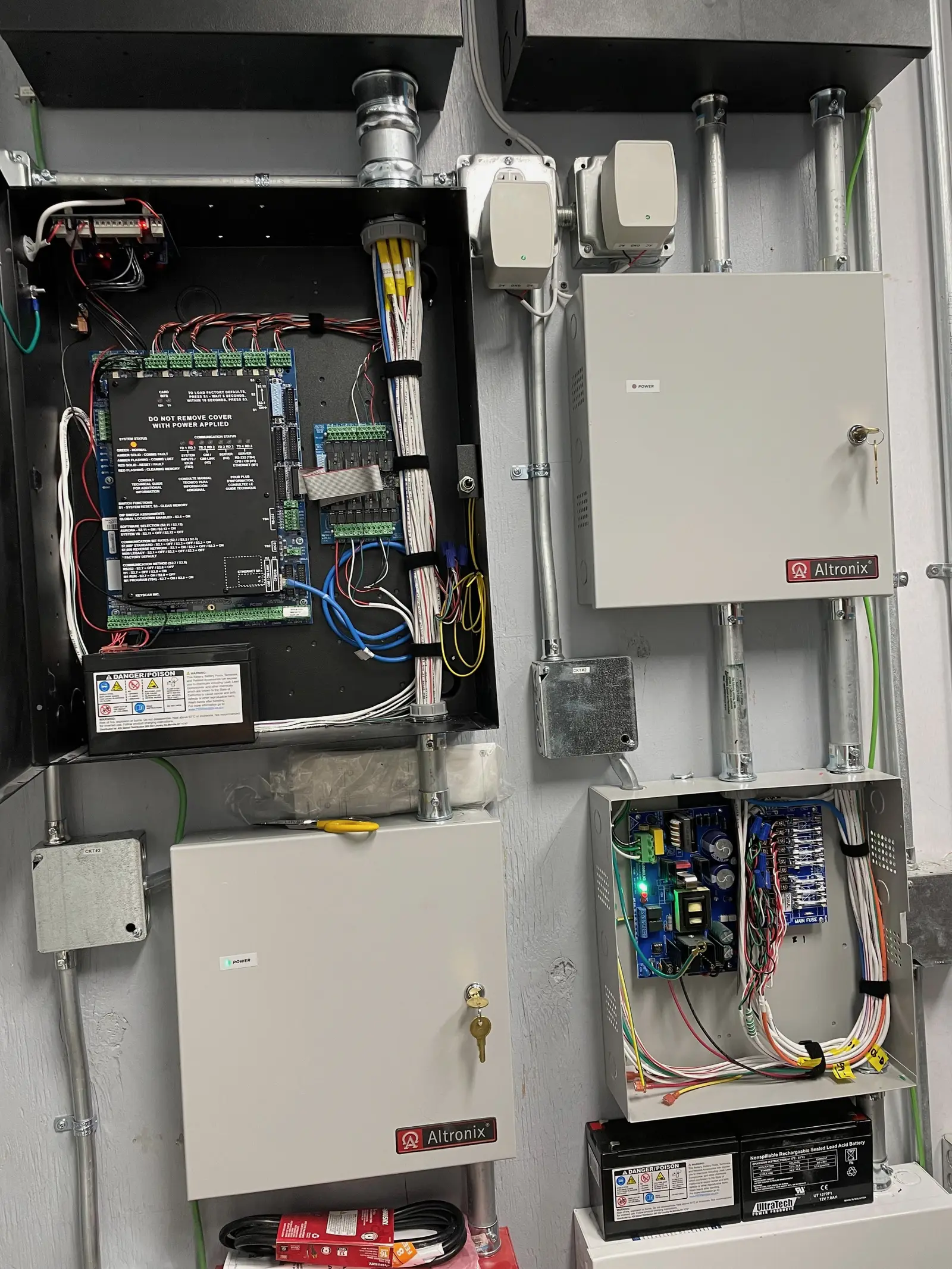
PLATE 01
An access control head end part way through installation, the controller enclosure open to show the main board wired to labelled terminal strips, a reader interface module on ribbon cable and a sealed battery below, alongside two closed power supply cabinets and a third opened onto its board and a formed loop of colour coded conductors, all fed by EMT conduit through junction boxes labelled with the circuit number.
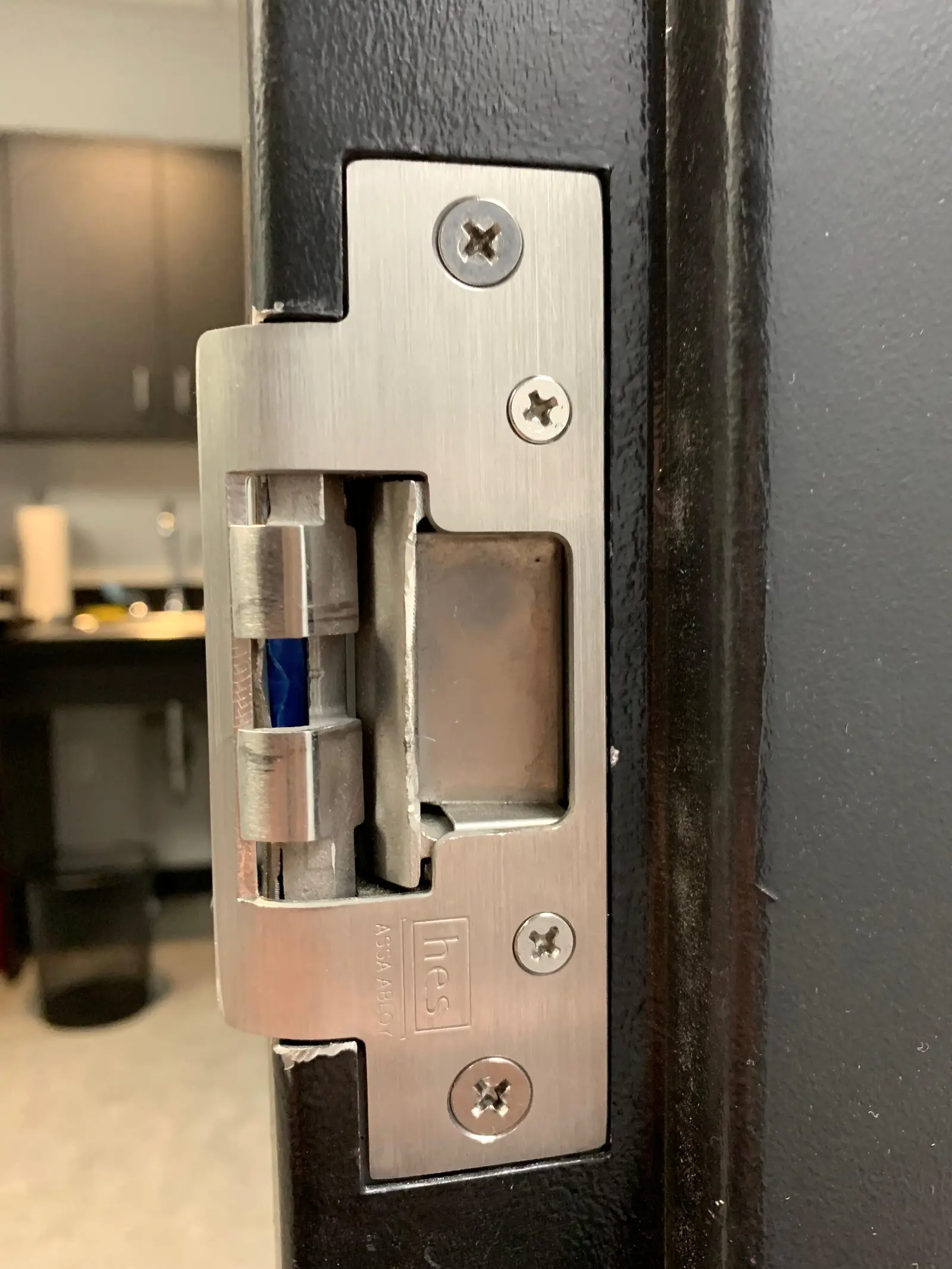
PLATE 02
Close up of a brushed stainless electric strike set into a dark steel door frame, its four screws seated flush, the keeper and solenoid visible in the open cutout with the blue coil lead behind them, and an out of focus interior beyond the doorway.
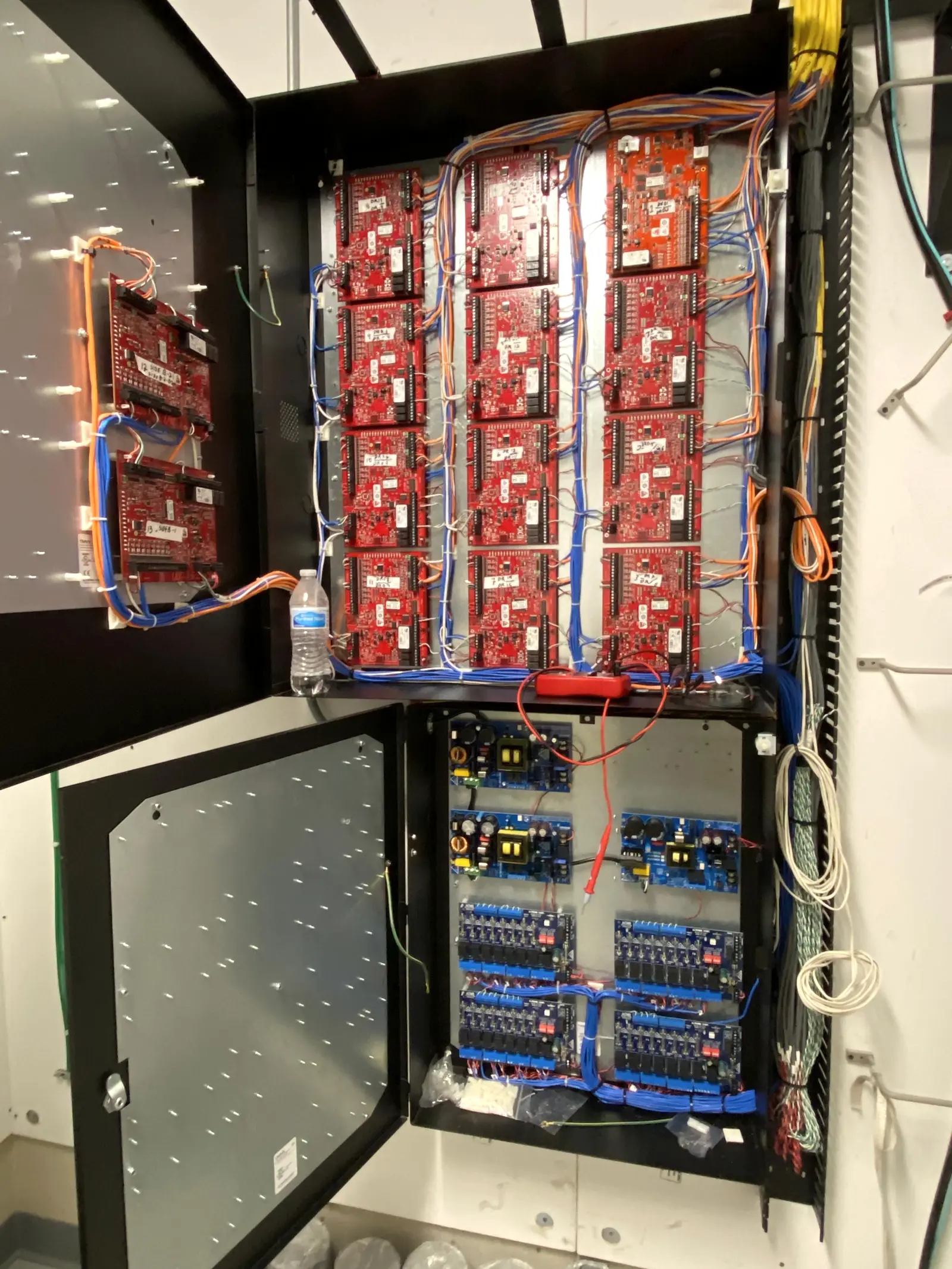
PLATE 03
An access control enclosure opened to show twelve door controller boards wired with labelled blue and orange conductors, above a separate power distribution section.
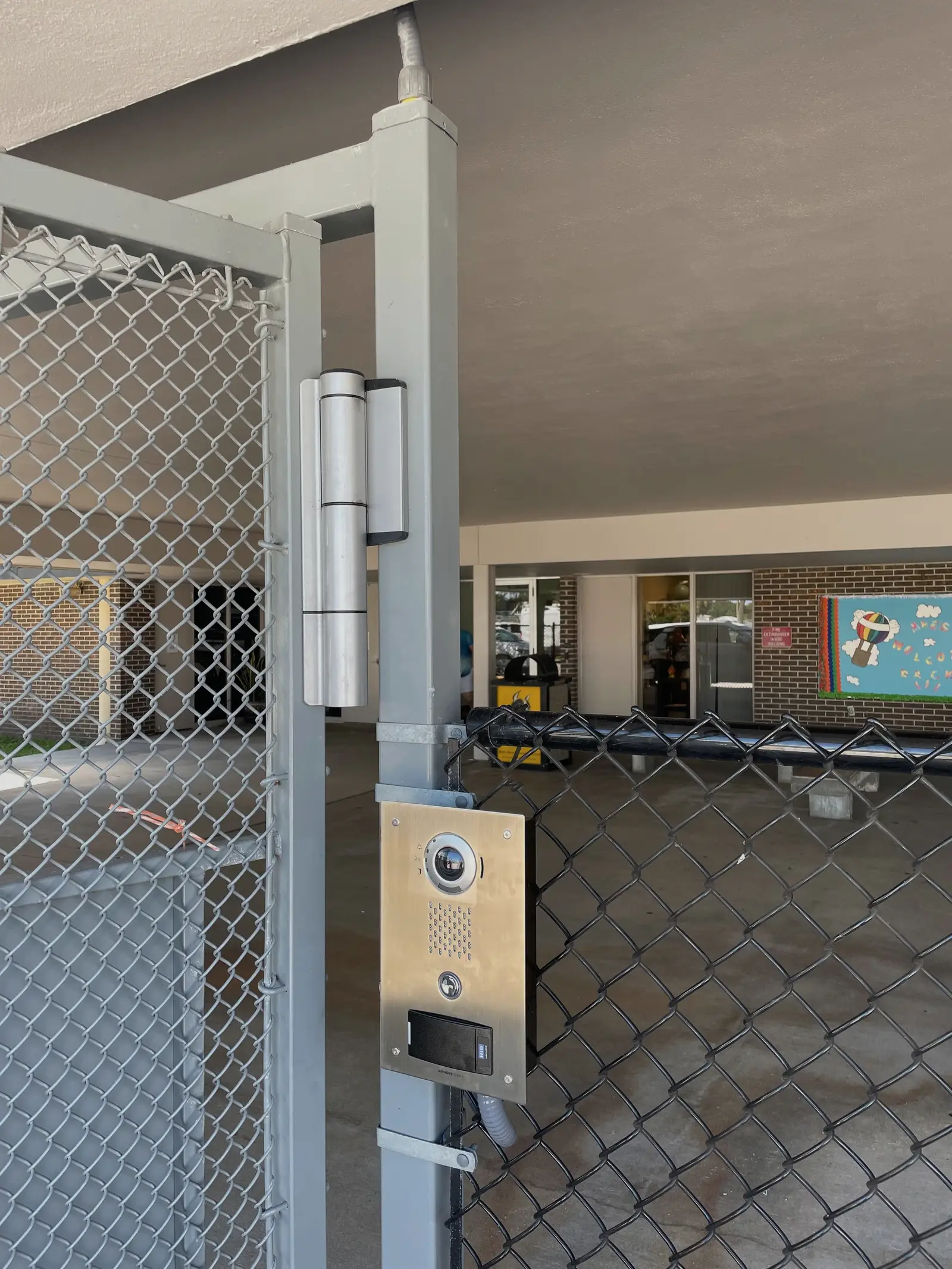
PLATE 04
A stainless video intercom with a card reader mounted on the post of a fenced pedestrian gate, with a heavy duty gate hinge above it.
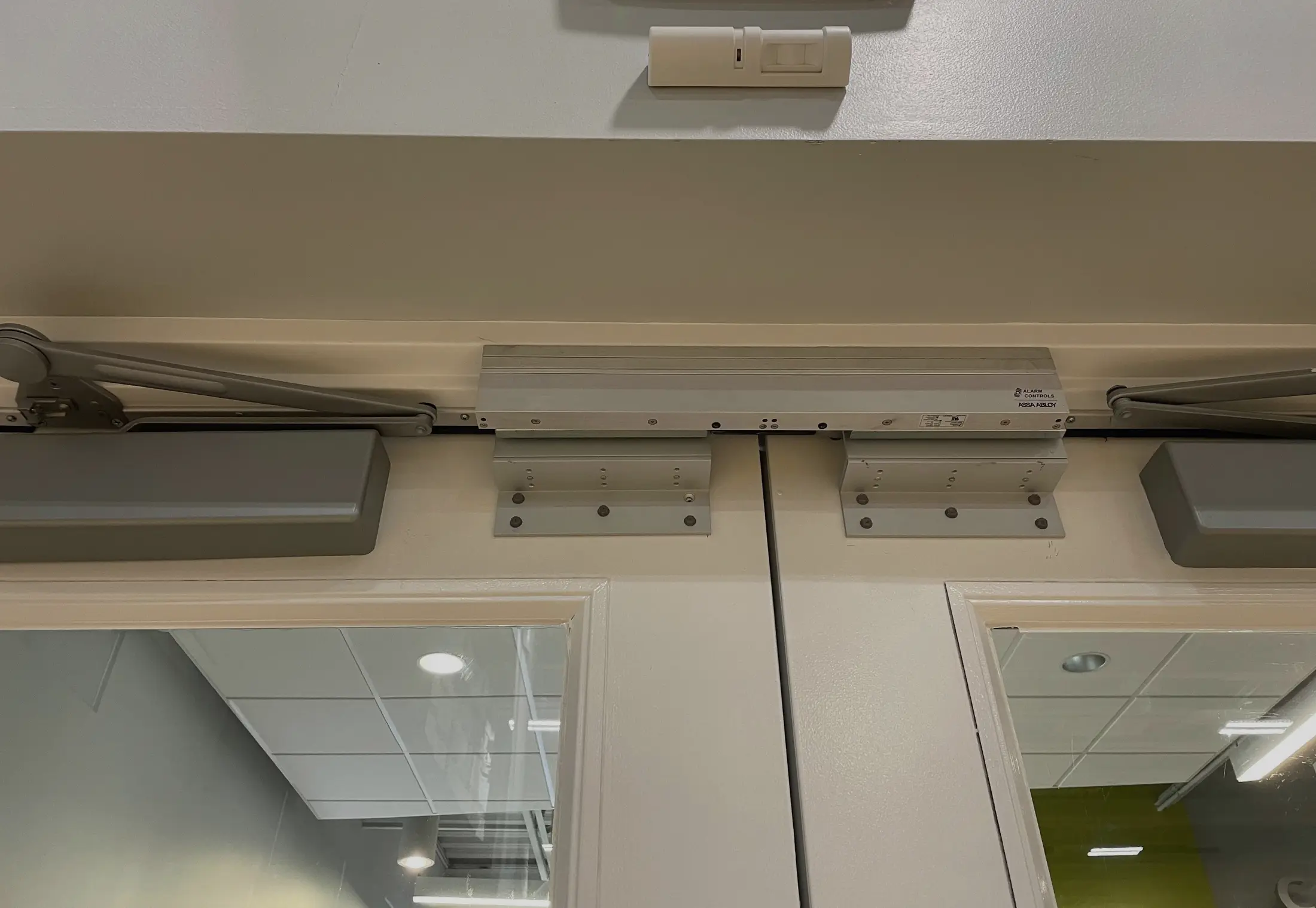
PLATE 05
A magnetic lock mounted across the head frame of a pair of doors, spanning both leaves on two bracket plates, with a request to exit motion sensor on the wall above and an overhead closer arm on each leaf.
CLIP 01 / ACCESS CONTROL
Testing the release on a finished door before handover.


What the work includes
- 01
A door-by-door survey with the floor plan marked up, and every controlled door numbered before the first cable is pulled
- 02
Card, fob and keypad readers, and video intercom stations at gates and lobby doors
- 03
Magnetic locks with the bracket set the frame actually needs, or electric strikes where the door should keep its own mechanical lock
- 04
Door position switches and request-to-exit sensors, so the system reports the real state of the door rather than the last command it was given
- 05
Controllers and power supplies mounted on a board with room to work, each lock on its own fused low-voltage output, and a sealed battery sized to carry the doors through an outage
- 06
Surge protection on the low-voltage lines leaving the cabinet, and conduit, surface raceway or in-wall pathway to every device
- 07
Boards, cables and power supply outputs labelled with the same door numbers as the plan
- 08
The credential list, schedules and door groups handed over in a state your staff can edit, and a walkthrough with whoever is going to run them
Common questions
- Should our doors get magnetic locks or electric strikes?
- It depends on the door rather than on preference. A magnetic lock holds the leaf shut with power and mounts on the head frame, so it is the answer for glass and aluminum entrances, pairs of doors and gates, where there is nothing to cut into. It also brings the exit side with it, because a door held by a magnet needs a request-to-exit sensor and usually a release button so people can leave without the system's cooperation. An electric strike goes into the frame and leaves the door its own mechanical lock, so it latches by itself and a key still works with the power off. On a solid door with a decent lockset already fitted, the strike is usually cleaner and less hardware. Most buildings end up with both, chosen opening by opening.
- If the power goes out, can people still get out of the building?
- How a door behaves in an outage is decided when the hardware is chosen, so it is worth asking before anything is ordered. A magnetic lock is held closed by power, so when the power stops the magnet releases and the door opens. An electric strike is usually specified the other way round, staying latched without power, but the door keeps its own mechanical lock, so the inside lever or the panic hardware opens it by hand and a key still works from outside. Between those, a sealed battery at each power supply keeps the doors and readers running through the kind of short outage South Florida produces regularly. Where an opening interacts with the building's life safety systems, that behavior is agreed with whoever maintains those systems before the lock is specified.
- Can you add doors to the access control system we already have?
- Often, and it is usually the cheaper route. Adding doors to an existing controller is ordinary work when the panel has spare capacity and the platform is still supported. Three things decide it: whether the manufacturer still supports that panel and software, whether the credentials already in your staff's pockets can still be read, and whether anybody can tell us how the existing doors are wired. The third is the one that sinks jobs, because an undocumented panel has to be traced before it can be extended, and that tracing is real time on the bill. Replacing a system that still works is the last option, not the opening position.
- What usually goes wrong on an access control system after it is installed?
- Rarely the software. It is normally something small and physical: a blown fuse on a lock output, a door position switch knocked out of alignment so the system reports a door held open that is closed, a reader cable damaged by another trade working above the ceiling, or a lock needing adjustment because the door has settled on its hinges. All of those are quick to find when the install was labelled, which is most of the reason to label it. You read the door number off the label and tell us, and whoever comes out knows which panel, which port and which supply to open before they get there.
Related services
Tell us about your project.
Send a few details and we will come back with a clear plan and a straight answer.