Structured cabling installation in Miami.
Labelled so the next person does not have to trace it.
EKB Network pulls, terminates, tests and labels Cat5e, Cat6, Cat6A and fiber for commercial and industrial properties across South Florida. Pathway goes in before cable. Drops are pulled in one continuous length. Both ends are terminated and tested, and each port gets a printed name that matches the outlet, the cable and the port list you keep. The photographs on this page are our own installs, so you can judge the standard before you call.

Bundles of blue, purple and aqua network cable strapped at even intervals along a J-hook pathway, sweeping around a corner and up into conduit sleeves above a stud wall.
Pathway first, cable second
The order decides everything downstream. Before the first cable comes off a reel, the route gets fixed: where cable can run, where it has to cross or stay clear of electrical, what has to be cored or sleeved, and how long the longest drop really is. Then the support goes in, conduit, wall sleeves, J-hooks or tray, so the cable is carried along its whole length instead of resting on ceiling tile or hanging off a pipe. Working in that order costs the same as working backwards. The difference shows up years later, when somebody needs to add a drop and finds either that there is room in the pathway or that there is not.
One address per port, and only one
A cabling job is bought once and troubleshot for a decade, which is why the naming scheme is the cheapest line on the quote and the one that decides what the next several years cost you. The rule is that a port has exactly one address: the same name on the patch panel, on the outlet at the desk and on the cable itself, so nothing is ever identified two ways. Where a room holds more than one panel, the panel becomes part of the name, because Port 12 stops meaning anything the moment there are two of them. Jack colour carries the same information without being read, so data drops and wireless access point drops separate at a glance. Which convention gets used matters far less than the fact that there is one, that it has room in it for the drops you have not asked for yet, and that it is written down. Reconciling a closet that already runs two or three competing schemes is a different job, and it is the one on the network rack cleanup page.
Hours, not cable, set the schedule
In an occupied office, restaurant, retail space or warehouse, the constraint is rarely the cabling. It is when we are allowed in the room. Work gets staged so the space is usable when you open: ceilings opened and closed inside the same shift, one area finished before the next is started, coring and anything dusty scheduled while the room is empty. A shell building is the opposite problem. The ceiling is open, the walls are still studs, the backbone goes in alongside the other trades, and the whole run is there to be looked at before anything closes. That is the cheap moment to leave spare capacity in the pathway, and it is the moment most people skip. Tell us how the building actually runs at the walkthrough, because the sequence of areas is easy to change then and expensive to change afterward.
Copper or fiber, and which copper
Copper stops being dependable past about 100 meters, and that limit, not a price list, settles most of this conversation. Cat6 covers gigabit and the PoE loads of ordinary cameras, phones and access points, and it is the sensible default for most rooms. Cat6A earns its cost on long runs, on high-power PoE devices, and anywhere you already know ten gigabit is coming. It also sheds heat better inside a full bundle, which matters more than people expect in a hot ceiling. Cat5e that is already in the wall and tests clean will still carry gigabit for most devices, and pulling it out so the building can be called Cat6 is money spent on a label. Fiber is for the backbone: closet to closet, building to building, anything past the copper limit, and runs between separate structures where electrical isolation is worth having. Pulling Cat6A everywhere sounds thorough and mostly just costs more.
The cable outlives everything you plug into it
Switches get replaced. Recorders get replaced. Phones, access points and cameras all get replaced, most of them more than once. The cable in the walls is the one part of the system still there in fifteen years, and the only part you cannot swap out over a weekend without opening the building up again. That is the whole argument for doing it properly the first time: the cost of pulling a run again is not the cable, it is the ceiling, the walls and the day nobody can work. Pathway with room left in it is what lets the next upgrade be a pull rather than a demolition.
From these jobs
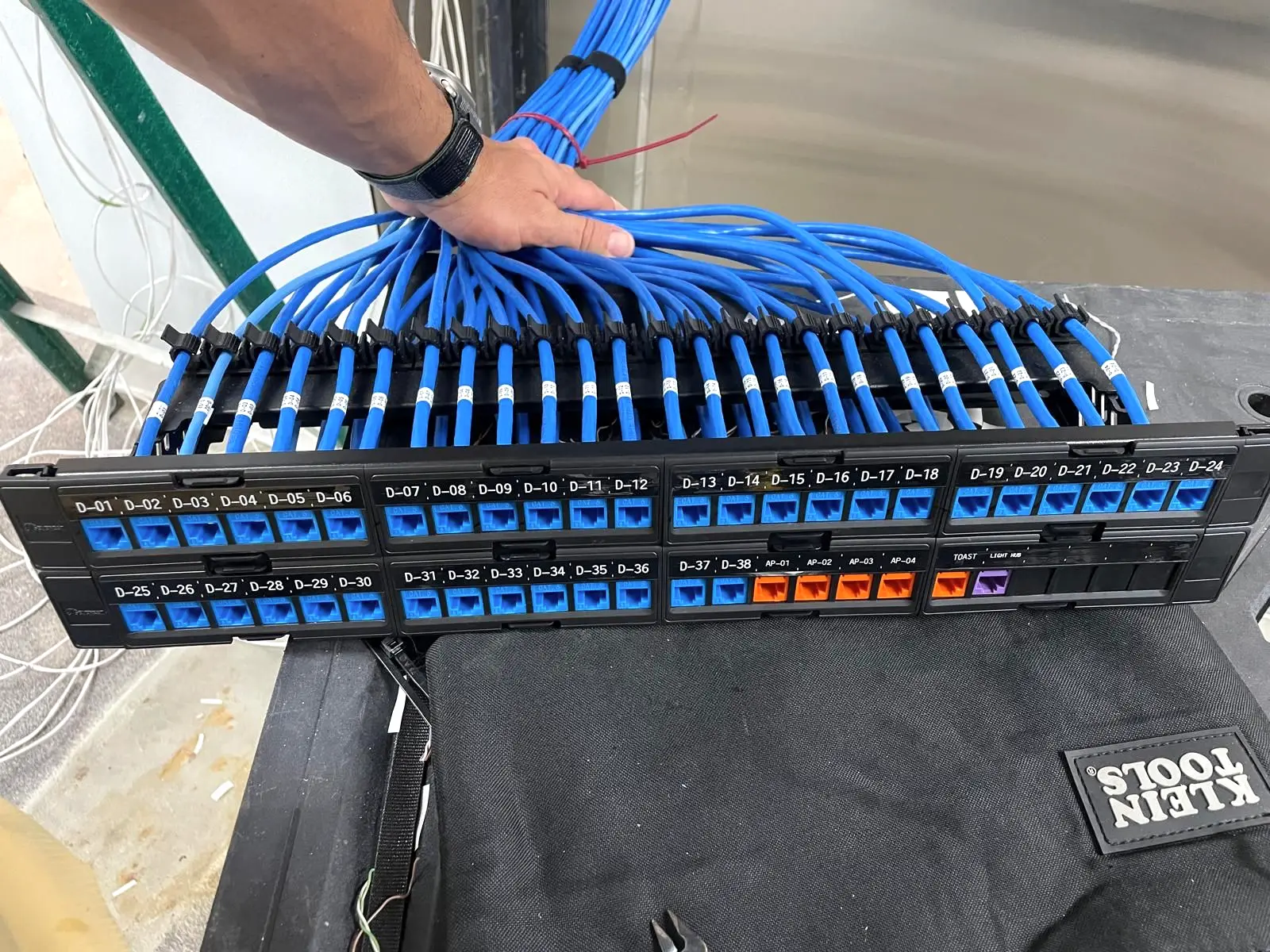
PLATE 01
A twenty four port keystone patch panel being terminated on a tool bag, with labelled blue jacks for data and orange jacks for wireless access points.
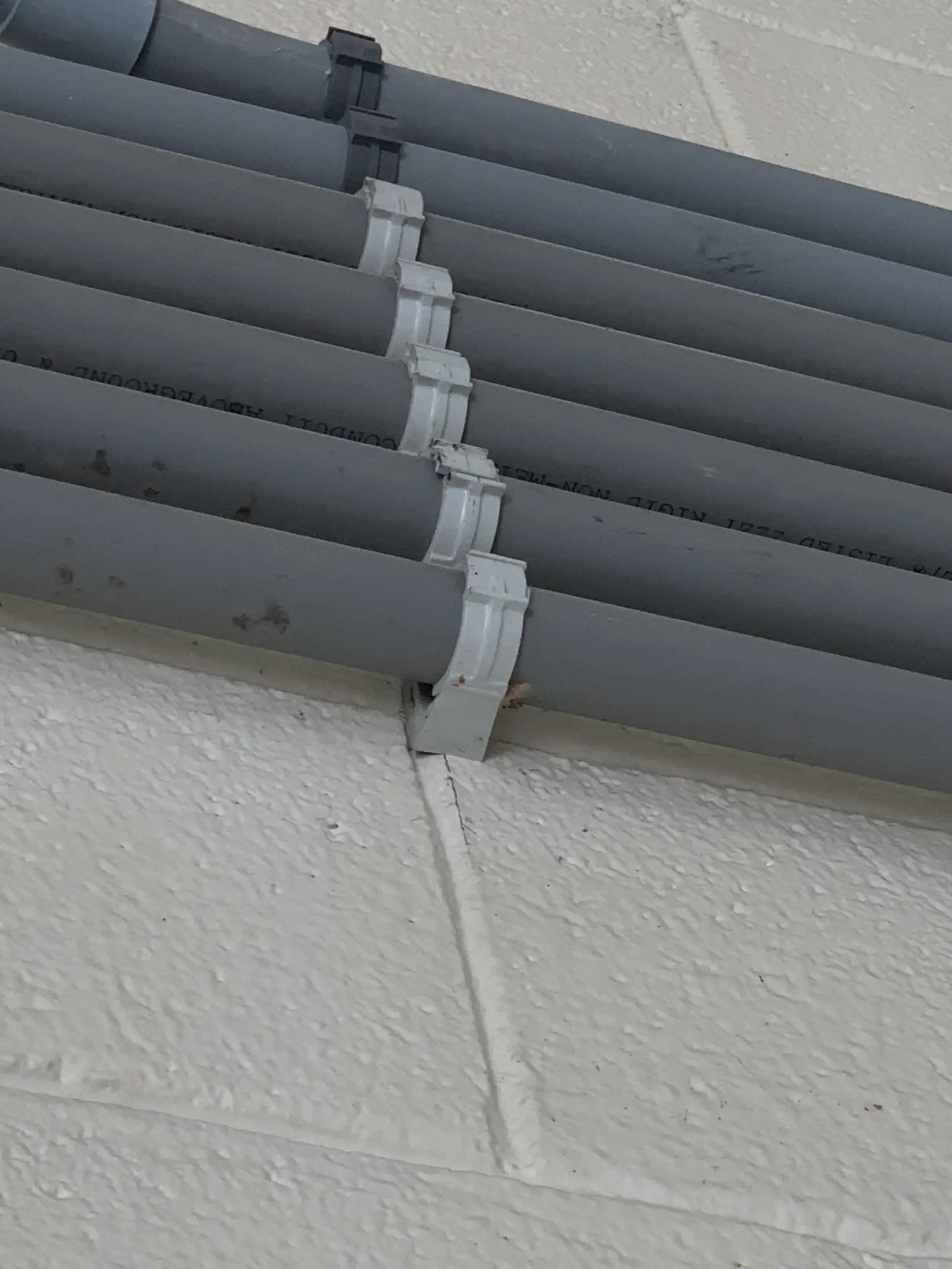
PLATE 02
A bank of grey rigid non metallic conduits running side by side across a painted block wall, each pipe held by its own clamp with the clamps stepping down one after another across the run, and the printed conduit legend still legible along the pipes.
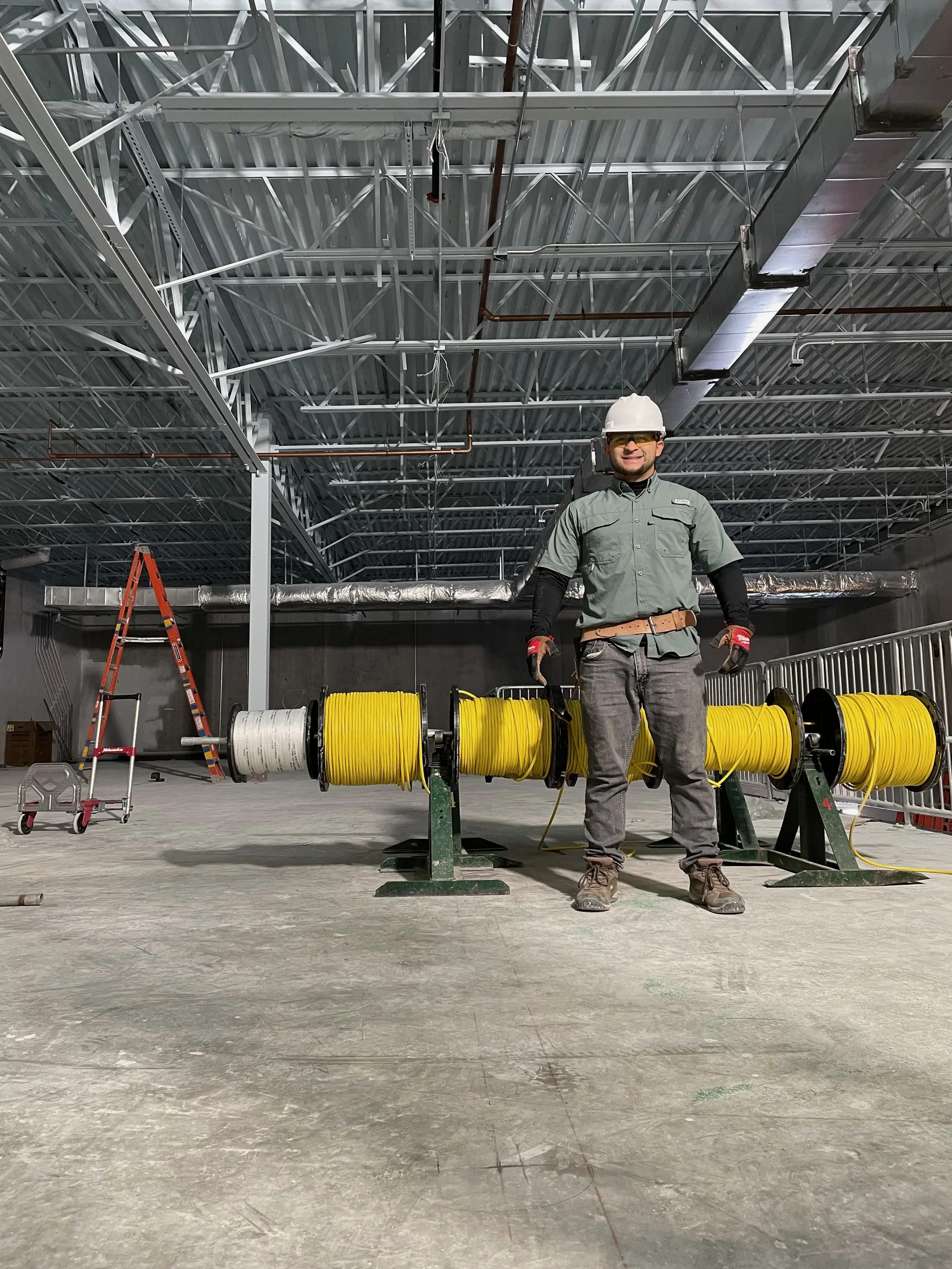
PLATE 03
A technician in a hard hat standing in front of four cable reels on jack stands inside a building under construction, with exposed steel joists and ductwork overhead.
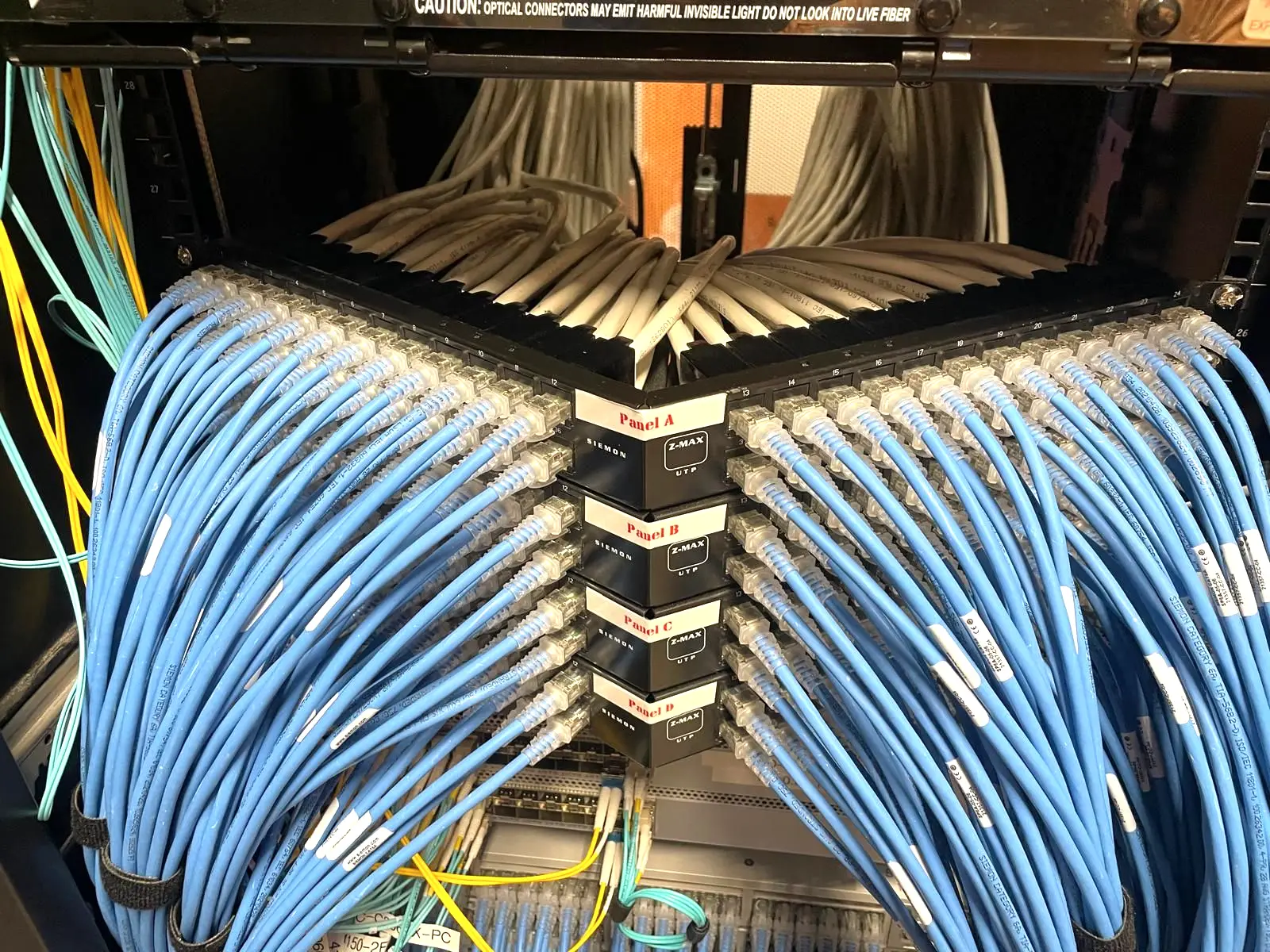
PLATE 04
Hundreds of blue patch cords fanning out from four labelled copper patch panels inside a network rack, with a grey cable trunk above and fiber pigtails at the side.
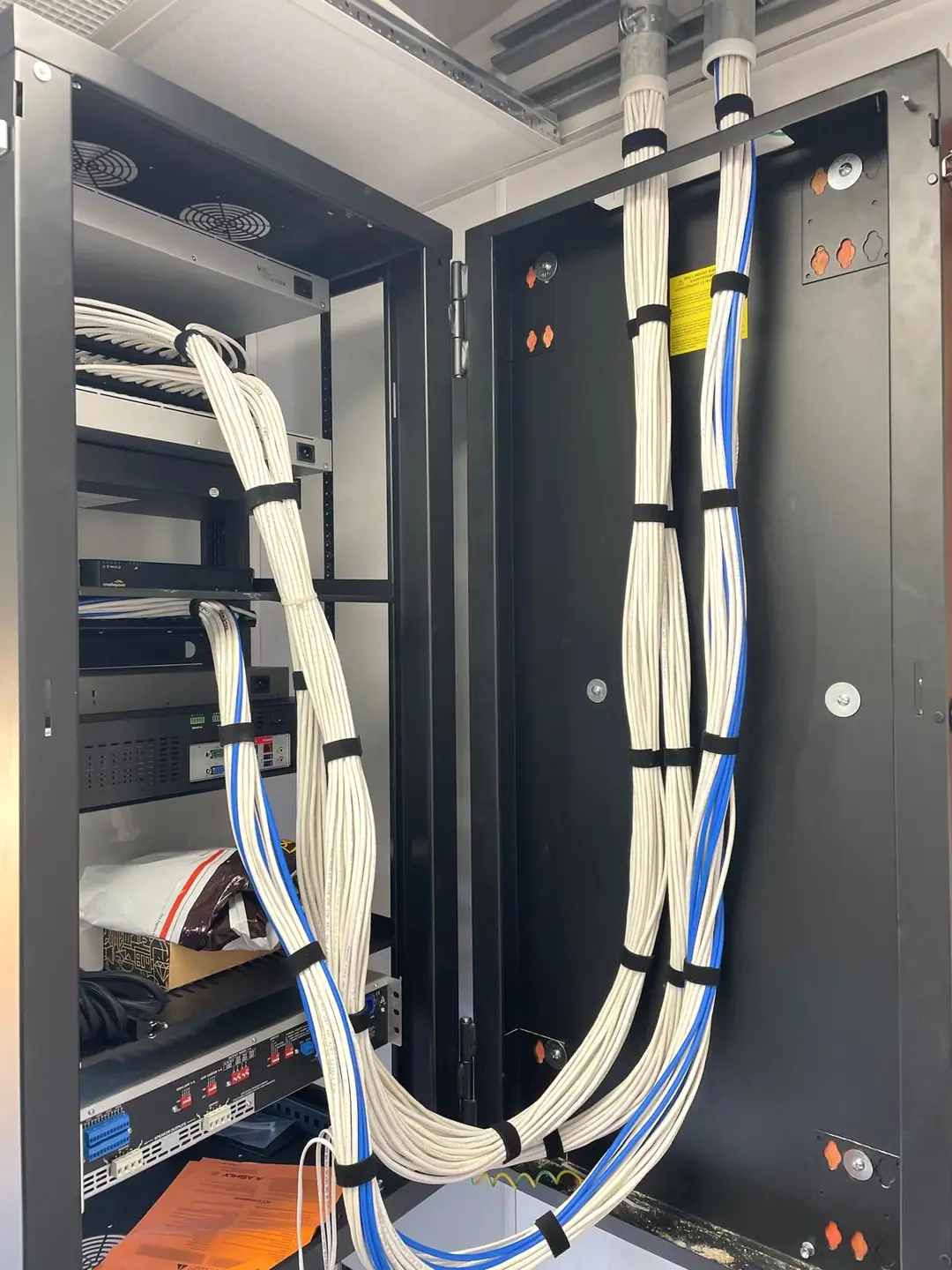
PLATE 05
White low voltage cable and blue network cable dropping out of ceiling conduit sleeves, strapped with hook and loop at even intervals and swept through a long service loop into an open wall mount cabinet holding a cellular router and rack mounted audio equipment.


What the work includes
- 01
A site walk and a pathway plan: conduit, wall sleeves, J-hooks and cable tray wherever the run needs support
- 02
Cat5e, Cat6 and Cat6A pulled from reels on stands, each drop in one continuous length rather than spliced mid-run
- 03
Fiber where distance, a building-to-building run or electrical noise makes copper the wrong choice
- 04
Cable kept clear of electrical, bend radius held through the corners, and hook-and-loop straps instead of over-tightened zip ties
- 05
Termination at both ends onto keystone jacks and patch panels, with jack color matched to what the port feeds
- 06
Every run tested end to end before the labels go on
- 07
Printed labels on the panel, on the outlet and on the cable, plus a port list that stays with the property
- 08
Outdoor and long runs landed in weatherproof enclosures, with surge protection on the PoE lines
Common questions
- Cat6, Cat6A or fiber: which does my building need?
- Cat6 is the sensible default for offices, restaurants, retail and most camera and access point runs, since it carries gigabit and the PoE those devices draw. Cat6A is worth paying for on long runs, on high-power PoE devices, and anywhere ten gigabit is already on the horizon, and it handles heat better inside a full bundle. Fiber is for the backbone between closets or between buildings, for anything past the roughly 100-meter copper limit, and for runs between separate structures where electrical isolation is worth having. Give us the distances and the device list and the answer is usually obvious.
- How far can one cable run before it needs something in the middle?
- About 100 meters, roughly 330 feet, from the patch panel to the outlet, and that limit is why most cabling conversations end where they do. It is not a manufacturer's preference, it is where copper stops being dependable. Past it you either put equipment somewhere in between, which means somewhere to put it and power to run it, or that leg goes to fiber. Which is cheaper depends on the building, so we measure the real route rather than the distance on a floor plan. The route is always longer than the straight line.
- Can you reuse the cabling already in our walls?
- Often, and it is worth checking before anyone quotes a rip out. Existing cable gets tested rather than assumed: a run that passes is a run you already own, and plenty of Cat5e still carries what a small office actually asks of it. What we will not do is call a cable good by looking at the jacket. Where the ends have been made badly enough that the fault will come back, we re-terminate rather than replace a sound cable. You are told which runs passed, which were fixed at the ends, and which need replacing.
Related services
Tell us about your project.
Send a few details and we will come back with a clear plan and a straight answer.