Network rack cleanup in Miami.
A rack nobody has to guess at.
We rebuild the network closet your business already runs on, in place, without swapping out your equipment. Each existing cable is traced back to what it actually feeds before anything moves, the panels, switches, recorder and rack outlets get printed labels, the slack is dressed and supported, and you keep the port list at the end. What you are buying is a room the next technician can read instead of unplug.

A floor standing network rack with patch panels, switches, a cellular router, a video recorder, labelled power outlets, an audio mixer, an amplifier and a UPS.
Nobody built it this way on purpose
These rooms are rarely the result of bad work. They are the result of ten small jobs that never spoke to each other. A cable went in for a camera. Two more went in when the office moved. The recorder arrived and somebody found a free port. Nothing failed, so nothing got written down, and what was known left the building with whoever did the last job. Then a port goes dead on a Tuesday afternoon and the only way to find it is to start pulling plugs until something else breaks. A cleanup is not cosmetic work. It is the difference between a fix that takes minutes and a morning spent guessing, and between a site any technician can pick up and a site one person understands.
Tracing comes before anything moves
The first part of a cleanup is not tidying, it is finding out what you already own. The rack is photographed as found and inventoried. Then each existing cable is toned back to the outlet or the device at the far end and tagged where it lands, so a patch cord is only moved once both of its ends are known. A cable nobody can account for is tagged as unidentified and left alone: an abandoned run and a live run for something nobody remembers look identical from the front of a rack, and cutting is the one step with no way back. That trace list is what the rest of the job is built on, and it is most of the reason a cleanup is worth paying for rather than attempting with a free afternoon and a label maker.
Rebuilt in an order that keeps you open
With the trace done, the rebuild runs one system at a time, so only one system is interrupted at a time: data, then cameras, then access control, then whatever feeds displays or audio. You get that sequence in writing before it starts, saying which system goes quiet, roughly how long for, and what is back up before the next one is touched. Most of the work is silent anyway. Tracing, labelling, dressing cable and writing the documentation all happen with the site running. Inside the cabinet, heavy equipment and the battery backup go low so the weight sits at the base, and the patch fields land where somebody can reach them standing up. Damaged ends are re-terminated, loose jacks re-seated, and patch cords sized to the path they actually take instead of looping back on themselves. Cable is combed into horizontal management between the panels and the switches, strapped with hook-and-loop at even intervals, given a service loop where it enters the cabinet, and nothing is cinched hard enough to deform a jacket. Each device cord is landed on the rack power strip and the outlet it uses is labelled, so the right plug comes out the first time.
Written for the technician who has never been here
The labelling is not for us. It is for the person who opens that door in two years: your IT provider, a technician from somewhere else entirely, or you at closing time. So the wall plate, the patch panel port and the switch port carry the same identifier, printed rather than written on tape, and the identifiers extend one scheme instead of starting a second. At handover you get a port list mapping each outlet to its panel port and its switch port, photographs of the rack front and back as it was left, and the label key itself, so a drop added later fits what is already there. A printed copy stays in the closet, because the file will be on a laptop that has left the building. With that in hand a dead outlet is often a phone call rather than a visit: read the label off the plate, and the panel port, switch port and rack outlet to check are all on the sheet.
From these jobs
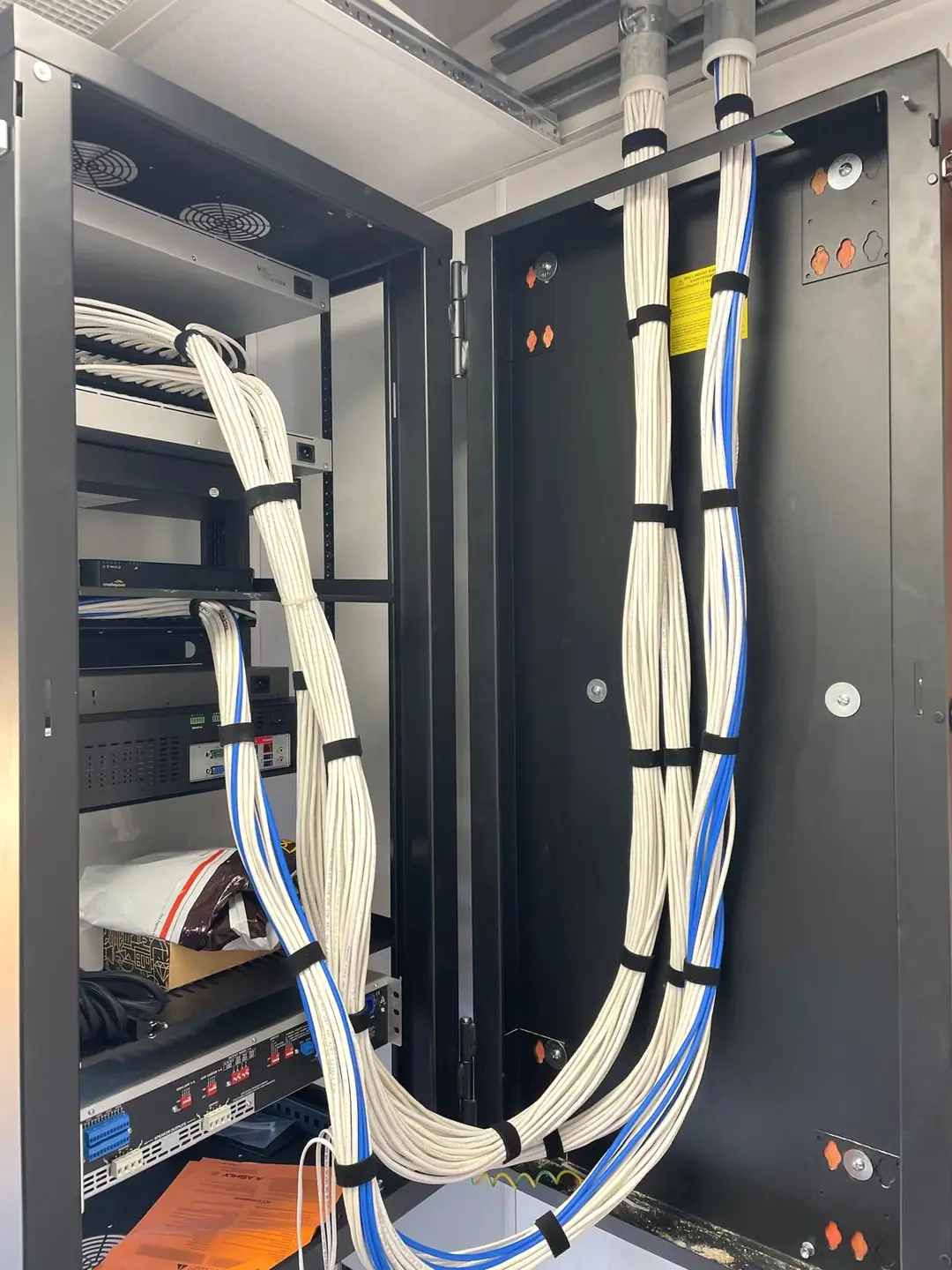
PLATE 01
White low voltage cable and blue network cable dropping out of ceiling conduit sleeves, strapped with hook and loop at even intervals and swept through a long service loop into an open wall mount cabinet holding a cellular router and rack mounted audio equipment.
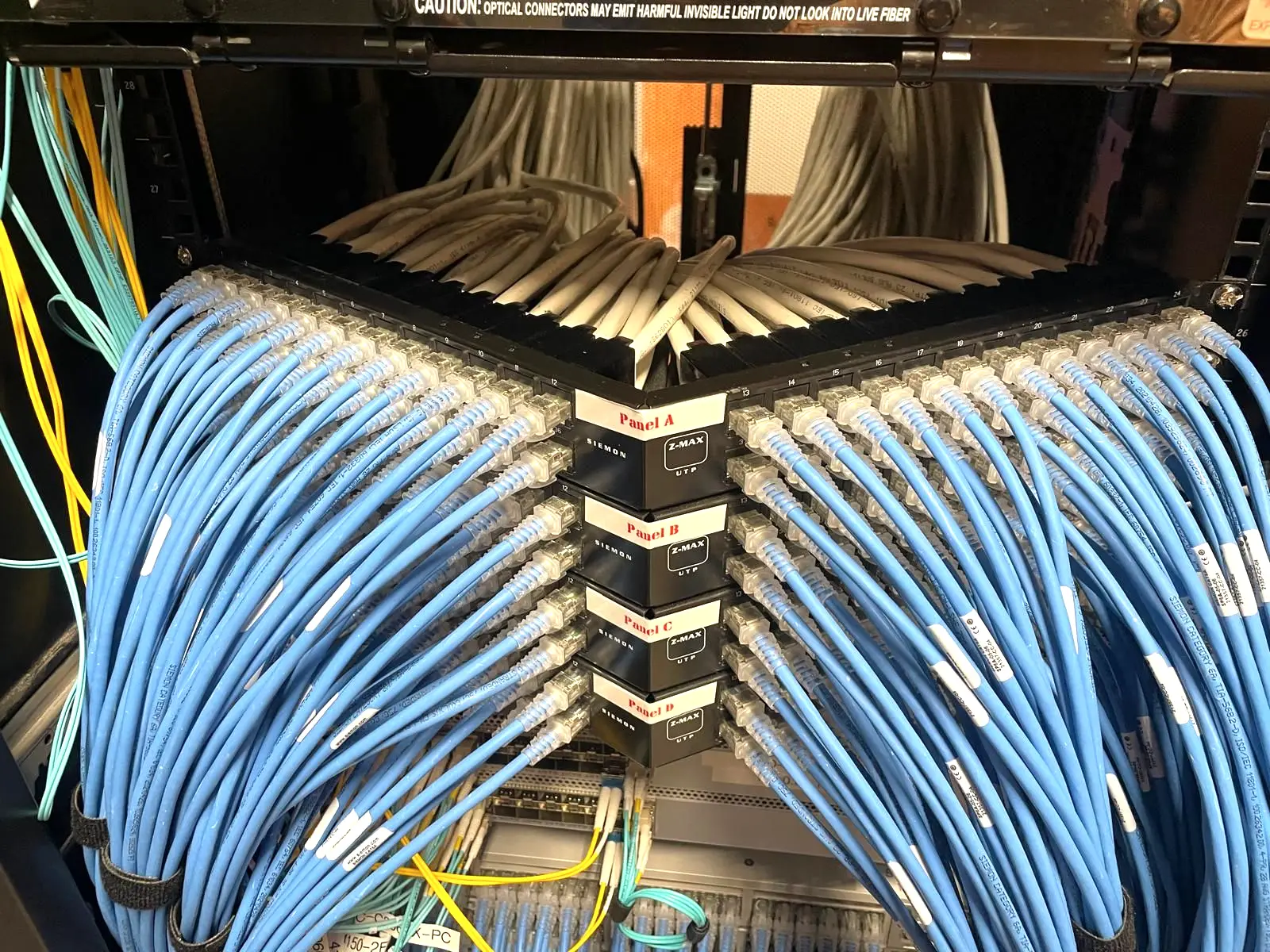
PLATE 02
Hundreds of blue patch cords fanning out from four labelled copper patch panels inside a network rack, with a grey cable trunk above and fiber pigtails at the side.
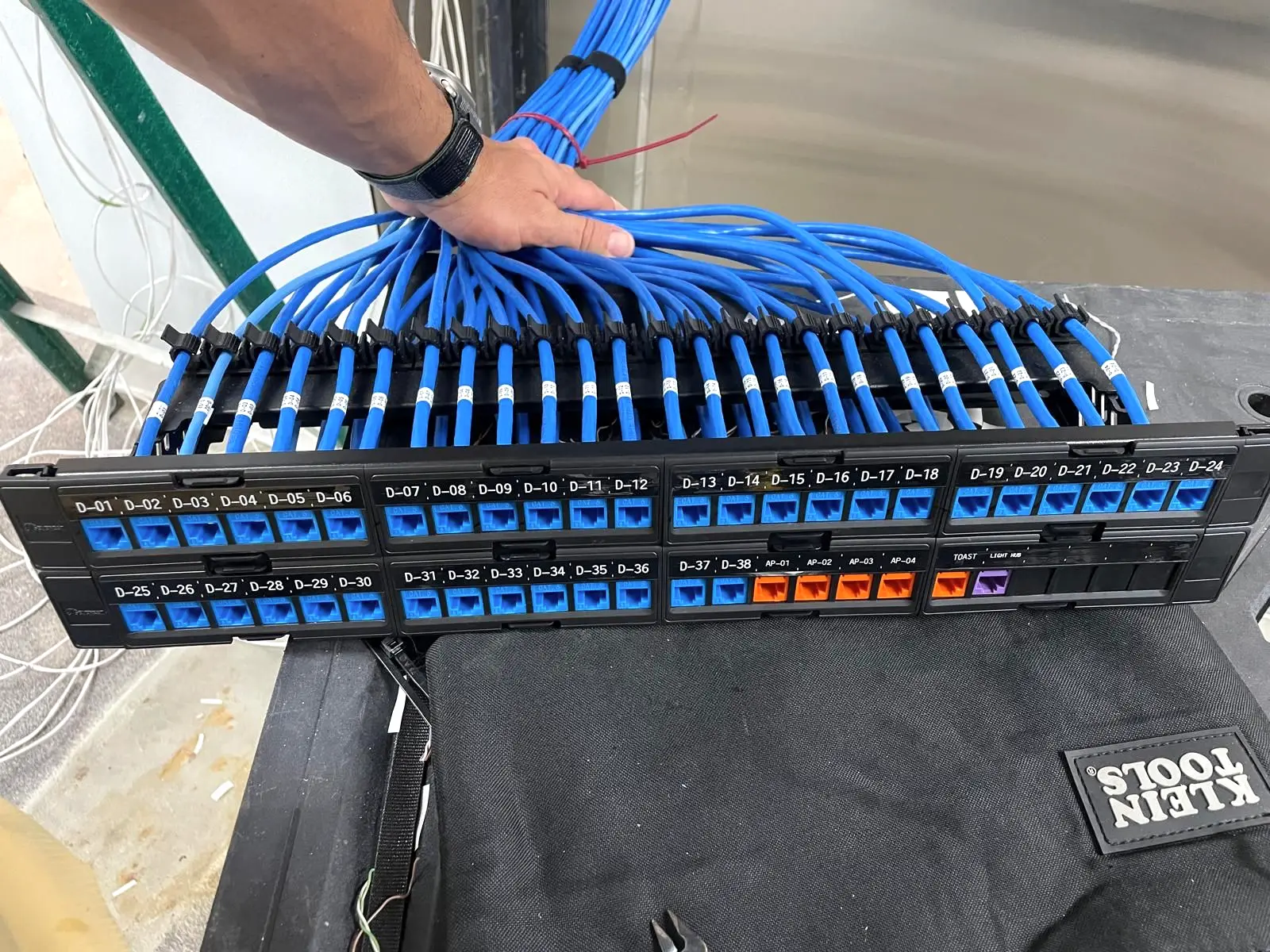
PLATE 03
A twenty four port keystone patch panel being terminated on a tool bag, with labelled blue jacks for data and orange jacks for wireless access points.


What the work includes
- 01
Each existing cable toned back to the outlet or device at the far end before anything is moved, including the ones nobody can account for
- 02
Unidentified runs tagged and left in place rather than cut, so an abandoned cable and a live one are not treated the same
- 03
One naming scheme agreed before the rebuild starts, so the wall plate, the patch panel port and the switch port read the same
- 04
Printed labels on the panels, switches, recorder, router and rack outlets, rather than marker on tape
- 05
Damaged or hand-made ends re-terminated, loose jacks re-seated, and patch cords sized to the path they take
- 06
Horizontal management between the panels and the switches, hook-and-loop straps at even intervals, and a supported service loop where cable enters the cabinet
- 07
Patch cords color-coded by service, so data, cameras, access control and the internet feed separate at a glance
- 08
A link test on the ports that were touched, plus a port list, handover photographs and the label key, with a printed copy left in the closet
Common questions
- Do we have to shut the network down while you work?
- Most of a cleanup happens with the site running. Tracing cable, labelling, dressing the bundle, sorting the rack outlets and writing the documentation interrupt nothing. The steps that do drop a link are short: moving a patch cord to its correct port, re-terminating an end, re-seating a panel. Those are grouped together, you are told in advance which system each one affects, and they run one system at a time, so the cameras and the point of sale are not out of service at once.
- What do you hand over at the end?
- A port list mapping each wall outlet to its patch panel port and its switch port, photographs of the rack front and back as it was left, and the label key, so whoever adds a drop later extends the same scheme instead of starting a second one. A printed copy stays in the closet with the rack. The point of the paper is that it survives staff changes and laptops leaving the building, which is how the room became unreadable in the first place.
- What happens to the cables nobody can account for?
- They get tagged and left alone. Every closet has them: runs going somewhere nobody remembers, from a job years ago. Cutting one because it looks dead is how a cleanup turns into an outage, and the cable nobody claims is quite often the one holding up a system nobody thinks about until it stops. So an unidentified run is toned as far as it goes, labelled as unidentified, and left connected. You finish knowing which cables are proven, which are spare, and which are still a question, which is more than most closets can say.
Related services
Tell us about your project.
Send a few details and we will come back with a clear plan and a straight answer.